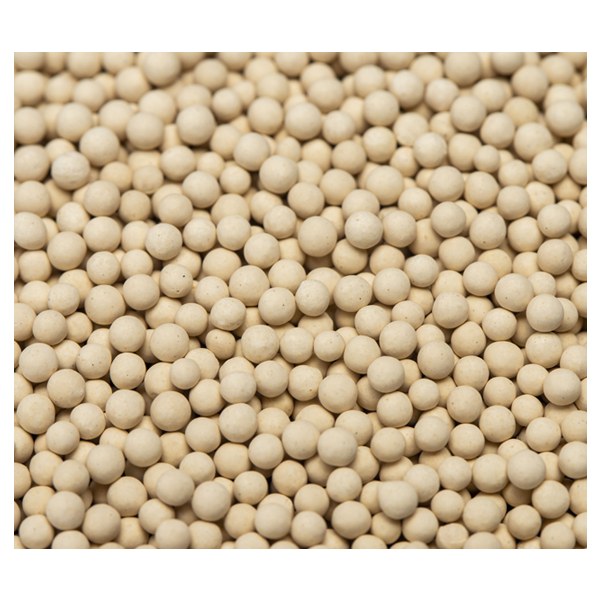
3A and 4A are the two most specified drying grades. They share the same zeolite framework — only the exchangeable cation differs, and that single change shifts the pore opening from about 3 Å to 4 Å. The decision is rarely about which is "better"; it is about which molecules you must keep out of the bed.
Pore size and what it excludes
3A is the potassium form, with pores near 3 Å. It adsorbs water but excludes most hydrocarbons — that is why it is the standard for cracking gas, ethylene and propylene, ethanol and polar solvents. 4A is the sodium form, near 4 Å; it also takes up CO₂, ammonia and small polar molecules.
Capacity and operating window
4A generally offers slightly higher static water capacity (around 22% vs 21%) and is the workhorse for natural gas, LPG, compressed air and refrigerant drying. 3A is chosen where co-adsorption of the product stream would cause loss or unwanted reactions, even at a small cost in capacity.
A selection rule that holds
If the stream contains hydrocarbons you must preserve, choose 3A. If you are removing bulk water from a gas or liquid where CO₂ removal is harmless or welcome, 4A is usually the economical choice. Confirm against the batch COA and a breakthrough test on your actual feed.