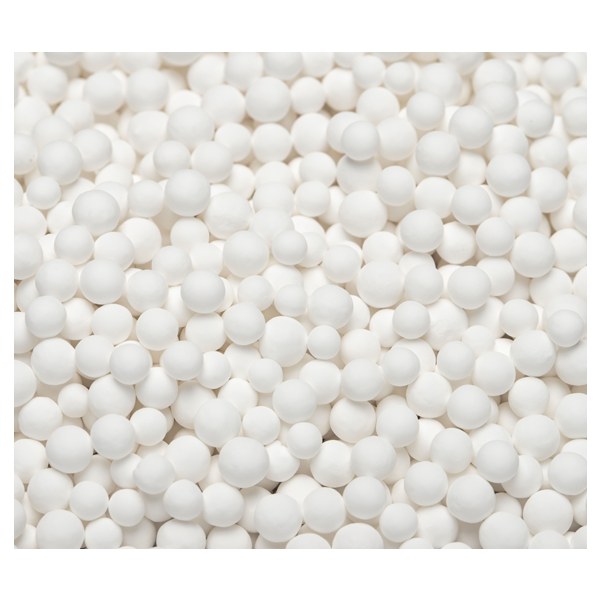
Standard 13X and 13X-APG share a sodium-X framework and roughly 10 Å pores. The difference is in how the grade is engineered and qualified: APG targets the front end of an air separation unit, where H₂O and CO₂ must both be driven to very low levels before the cold box or the channel freezes.
Why the cold box sets the spec
In an ASU, residual CO₂ and water freeze at cryogenic temperatures, foul heat exchangers and force unplanned shutdowns. Prepurification is not a polishing step — it is a reliability requirement. APG grades are qualified for simultaneous deep removal rather than bulk drying alone.
What is actually different
Expect tighter control of CO₂ capacity at low partial pressure, higher crush strength for large beads in layered beds, and low residual moisture ex works. Standard 13X remains the right choice for general gas purification, H₂S removal and catalyst support, where APG-level qualification is not needed.
Do not mix grades by assumption
Treat 13X and 13X-APG as different specifications, not interchangeable names. Ask for the batch COA with CO₂ and water breakthrough data at your operating pressure, and design the alumina guard layer together with the sieve bed.